How to Describe an Image in Words: A Guide to Visual Imagery in Writing

Aviso de linguagem de conteúdo
Este conteúdo ainda não está disponível em Português. Em vez disso, estamos mostrando a versão English.
Experimente Você Mesmo!
Quer colocar este guia em prática? Use nossa ferramenta gratuita Imagem para História para obter resultados instantâneos.
How to Describe an Image in Words: A Guide to Visual Imagery in Writing
A photograph can hold a thousand emotions, but it takes precise language to share them. Whether you're a student writing a visual analysis essay, a novelist translating a reference image into prose, or simply someone who wants to articulate what they see — the ability to describe an image in words is one of the most useful writing skills you can develop.
This guide breaks down the techniques behind strong visual description, explains the different ways to describe imagery, and shows you how to use AI to instantly describe an image to text when you need a first draft fast.
What Is Imagery in Writing?
In writing, imagery refers to language that creates a vivid mental picture by engaging the reader's senses. It's not just about what something looks like — strong imagery reaches beyond sight to include sound, smell, touch, and even taste.
When you describe an image in words, you're not writing a caption. You're translating pixels into feelings. The goal is to make the reader experience the image without seeing it.
There are five main types of sensory imagery:
| Type | Sense | Example |
|---|---|---|
| Visual | Sight | "The sky bled orange and violet above the treeline." |
| Auditory | Sound | "Even in stillness, the image feels loud — all crashing waves and seagull cries." |
| Tactile | Touch | "The rough wood grain of the dock runs under your fingers." |
| Olfactory | Smell | "You can almost smell the salt and diesel of the harbor." |
| Gustatory | Taste | "The warmth in the scene evokes the sweet weight of summer fruit." |
Most visual description leans on visual + tactile imagery, but the best writers layer in multiple senses to create immersive, three-dimensional prose.
Ways to Describe Imagery: The Core Techniques
Before you write a single word, you need a framework. Here are the proven ways to describe imagery that writers and writing teachers have used for decades.
1. Lead with Light and Color
Light is what makes images visible — and it carries enormous emotional weight. Before describing subjects, describe the quality of light.
- Is it harsh and direct, casting sharp shadows?
- Soft and diffuse, as through fog or curtains?
- Golden (morning/evening), blue-white (midday), grey (overcast)?
Color follows light. Go beyond basic color names: not "blue" but "the washed-out blue of faded denim" or "a blue so deep it feels like a held breath."
2. Establish Foreground, Midground, Background
Strong visual description moves through space deliberately. Structure your description like a camera:
- Foreground: What is closest? What immediately catches the eye?
- Midground: What connects the foreground to the background?
- Background: What is the world this image exists in? Sky, horizon, architecture?
This creates a sense of depth and stops descriptions from feeling like a flat list of objects.
3. Use Figurative Language
Metaphor and simile are the writer's zoom lens — they connect the unfamiliar to the familiar.
- Simile: "The lighthouse stands like a pale finger pointing at the clouds."
- Metaphor: "The abandoned building is a broken tooth in the city skyline."
- Personification: "The ancient oak reaches toward the light with desperate arms."
Avoid clichés ("crystal clear water," "golden sunset") and reach for comparisons that feel specific and fresh.
4. Name the Mood, Not Just the Content
Every image has an emotional atmosphere. Don't just describe what you see — describe how it feels.
A photograph of an empty park bench can be peaceful, lonely, melancholic, or hopeful — depending on the light, the angle, the season. Read the mood and name it in your language.
5. Use Negative Space
What isn't in the image is often as telling as what is. The emptiness of a vast sky above a single figure. The bare wall behind a full bookshelf. Describing absence creates tension and meaning.
How to Describe the Ocean with Imagery: A Worked Example
One of the most common requests in writing classes is to describe the ocean with imagery — and it's a perfect test case because the ocean is simultaneously familiar and endlessly varied.
Here's how to approach it using all the techniques above:
Start with light:
The water isn't blue — not exactly. In the flat midday light, it's a hammered pewter, surface fractured into a thousand shifting planes.
Add foreground and depth:
Nearest to shore, a thin line of white foam reaches and retreats, reaches and retreats, leaving dark wet sand in its wake. Farther out, the swells rise and collapse in long, slow rhythms.
Layer in other senses:
The sound is total — not a roar, but an enveloping hiss, like the whole world whispering at once. The air tastes of salt and something mineral, something ancient.
Close with mood:
Standing here, you understand why sailors once believed the ocean was alive. It breathes. It shifts. It waits.
Notice that this description never once uses the words "beautiful," "amazing," or "peaceful" — yet the mood is unmistakable. That's the goal of strong imagery: show, don't tell.
Step-by-Step: How to Describe Any Image in Words
Apply these steps to any picture — a landscape, a portrait, an abstract painting:
Step 1: Look without writing. Spend 30 seconds just observing. What is your eye drawn to first? What is in the background? What is the light doing?
Step 2: Write a single sentence that captures the most important thing. This is your anchor. Everything else supports it.
Step 3: Add light and color. Work through the image systematically — sky, shadows, highlights, dominant palette.
Step 4: Describe subjects and their relationships. Not just "a woman stands by a window" but how she stands, how the light falls on her, what the window reveals.
Step 5: Add one sensory detail from a non-visual sense. Sound, smell, texture — this single addition often transforms a flat description into an immersive one.
Step 6: Read it aloud. Imagery should flow. If it sounds like a list, restructure it into sentences that move.
How AI Can Help You Describe an Image to Text
If you're working fast — drafting a story, preparing a writing exercise, or just want a strong first draft to edit — AI can describe an image to text in seconds.
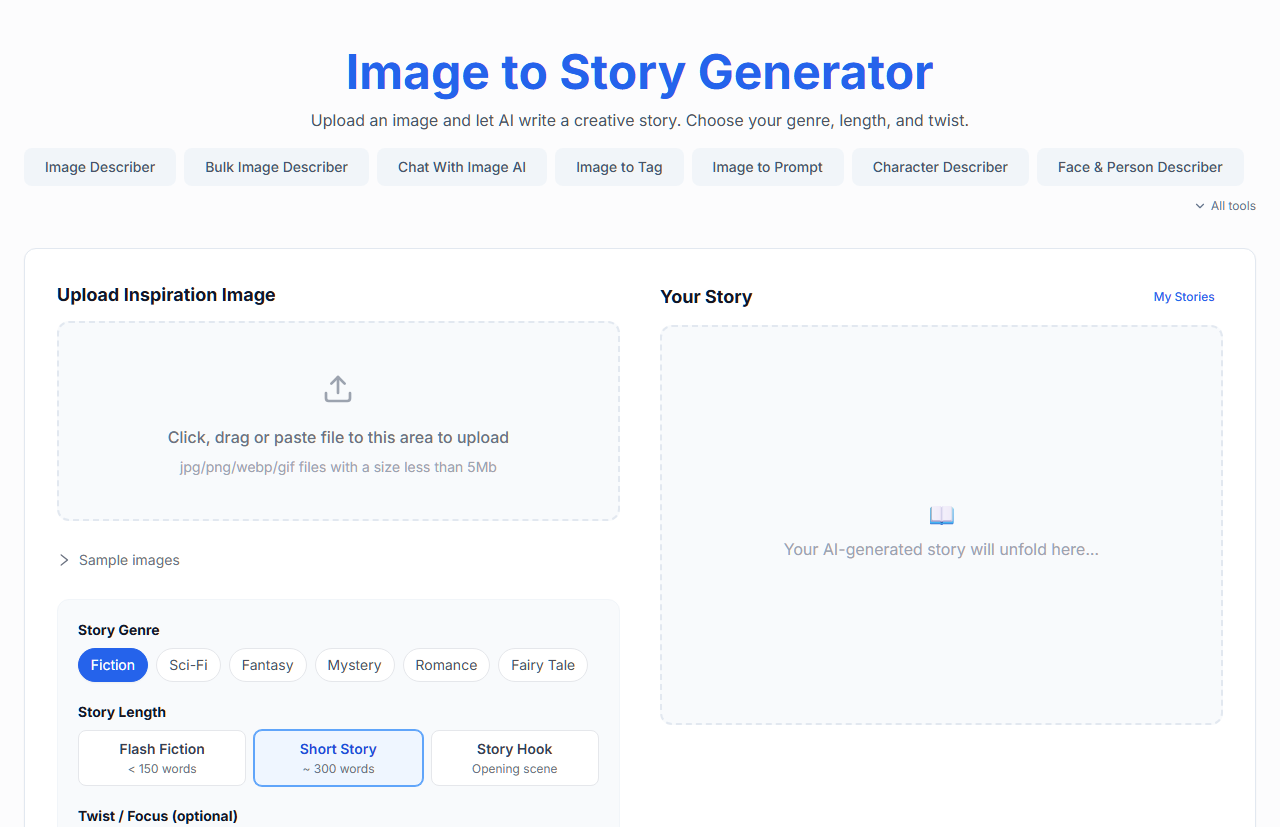
Our Image to Story Generator is built for exactly this. It analyzes any image and produces a written description or story, with full control over:
- Genre: Fiction, Sci-Fi, Fantasy, Mystery, Romance, Fairy Tale
- Length: Flash Fiction (<150 words), Short Story (~300 words), or a Story Hook (just the opening scene)
- Custom Focus: You can steer the output — "focus on the light and atmosphere" or "describe this from the perspective of someone afraid of the dark"
Step-by-Step: Using the Image to Story Generator
Step 1: Upload Your Image
Go to the Image to Story Generator and drop in your image — a photograph, illustration, screenshot, or any picture you want to describe. You can also paste directly from clipboard.
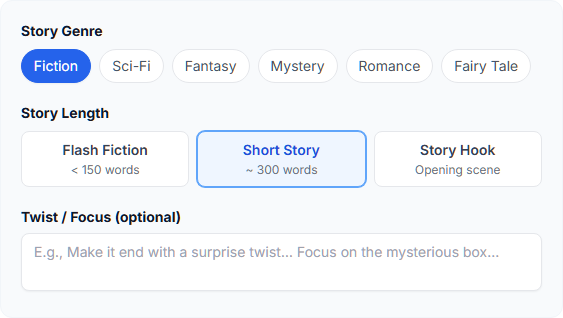
Step 2: Choose a Genre
Select the genre that fits your purpose:
- Fiction — for general, literary prose descriptions
- Fantasy / Sci-Fi — for speculative, world-building language
- Mystery — for atmospheric, tension-loaded descriptions
- Romance — for emotionally warm, sensory-rich language
- Fairy Tale — for lyrical, timeless, archetypal descriptions
Step 3: Choose a Length
- Flash Fiction if you need a tight, punchy image description (great for social media captions or writing prompts)
- Short Story if you want a full narrative that uses the image as its starting point
- Story Hook if you want just the opening — the first paragraph that would pull a reader in
Step 4: Add a Custom Focus (Optional)
This is where the tool gets powerful. Type a specific instruction:
- "Describe the mood and atmosphere, not the literal content"
- "Write from the perspective of a child seeing this for the first time"
- "Focus on the ocean — its sound, its smell, its texture"
Step 5: Click Generate and Refine
The AI will produce a full written description in seconds.
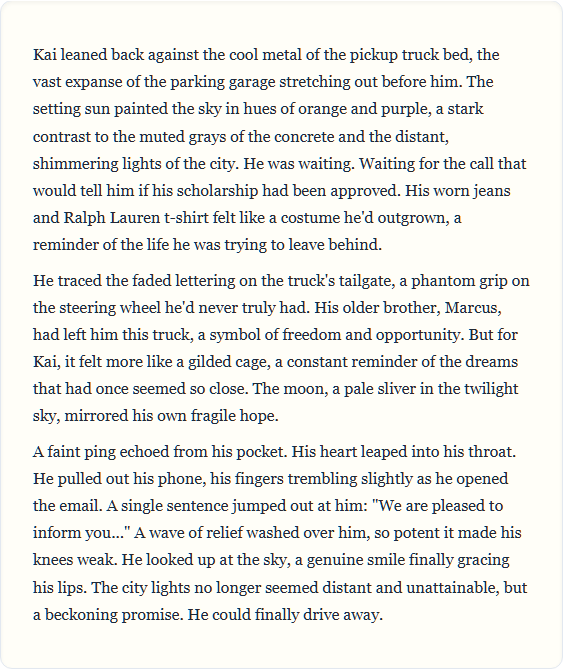
Use this as your first draft. The best approach is to take the AI's output and edit it — swap out generic phrases, add your own observations, inject your specific voice.
When to Write Manually vs. When to Use AI
| Situation | Approach |
|---|---|
| Writing an essay or exam | Manual — you need to demonstrate your own technique |
| Fiction writing, first draft | AI → then edit heavily |
| Creative writing exercises | Try both: write first, then compare to AI output |
| Social media captions | AI for speed, then personalize |
| Learning to write imagery | Manual — the process is the lesson |
The AI is a tool, not a replacement for craft. But as a way to break through a blank page, or to see an image from an angle you hadn't considered, it's genuinely useful.
Summary
Learning to describe an image in words is fundamentally about translation: converting what the eye sees into language that makes the reader feel. The key techniques are:
- Lead with light and color
- Move through depth (foreground → background)
- Use figurative language (fresh similes and metaphors)
- Name the mood, not just the content
- Layer in non-visual sensory details
When you need a first draft instantly, use our Image to Story Generator to convert any picture into vivid prose — then refine it with your own voice and observations.
The ocean waits. Describe it.
Experimente Você Mesmo!
Quer colocar este guia em prática? Use nossa ferramenta gratuita Imagem para História para obter resultados instantâneos.